


ICPE: Essential Guide 2025 – 100% Free
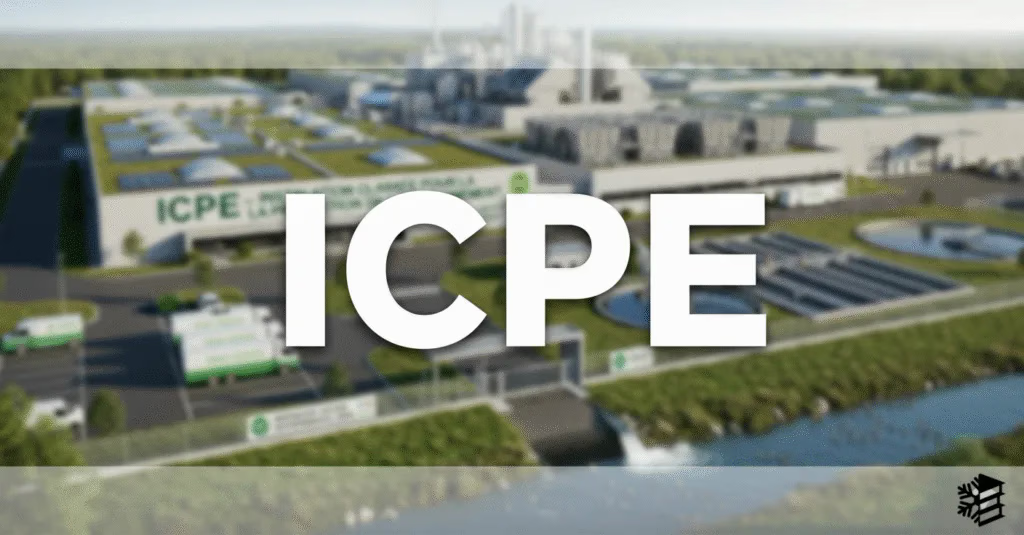
The term ICPE refers to Installations Classées pour la Protection de l’Environnement (ICPE facilities - Installations Classified for Environmental Protection). These industrial, artisanal, or agricultural sites are regulated by law because they present potential risks to:
- human health (pollutant emissions, noise, dust),
- safety (fire, explosion, gas or refrigerant leaks),
- the natural environment (soil, water, biodiversity).
France has more than 500,000 ICPE facilities, ranging from small agricultural operations to Seveso-classified chemical plants.
Among the most common ICPE facilities are cold rooms and industrial refrigeration installations, subject to specific requirements due to the use of refrigerants (R-134a, R-404A, CO₂, ammonia, etc.). This is why the subject of ICPE refrigeration declaration has become central in many sectors (agri-food, logistics, mass retail).
Why use ICPE teledeclaration?
Since January 1, 2016, teledeclaration has been mandatory for all ICPE facilities subject to the declaration regime (D or DC). This dematerialized procedure replaces old paper forms and offers several advantages:
Simplicity and accessibility The Entreprendre.Service-Public.fr online service is open 24/7, with the possibility to save your file while entering data.
Time saving The operator immediately receives an electronic receipt, official proof of submission.
Legal security In case of inspection, the company can prove its regulatory compliance.
Enhanced traceability The administration and the operator have access to the same digital history of declarations.
ICPE refrigeration declaration: a practical case
Refrigeration installations are among the closely monitored activities under the ICPE framework, as they handle fluids potentially dangerous to health and the environment.
Concrete examples
Hypermarket with cold rooms A hypermarket with multiple cold rooms must teledeclare its installation if volumes exceed certain thresholds set in the ICPE nomenclature.
CO₂ logistics platform A logistics platform equipped with a CO₂ refrigeration plant is subject to periodic control (DC).
Ammonia agri-food factory An agri-food factory using ammonia for cooling must not only teledeclare, but also comply with specific requirements related to fire safety and leak prevention.
In practice, ICPE declaration teledeclaration allows the operator to quickly obtain an official receipt and ensure the regulatory compliance of their installation before commissioning.
Source: Youtube – Drouot Avocats
Steps of ICPE teledeclaration
1. Check if the activity is subject to ICPE declaration
The ICPE nomenclature lists the concerned categories. For refrigeration installations, thresholds are related to:
- the type of refrigerant used,
- the total storage volume,
- the installed refrigeration capacity.
2. Prepare the ICPE file
A teledeclaration file generally includes:
- the operator’s identity,
- the precise location of the installation (address, plan, GPS coordinates),
- the description of activities and processes,
- operating conditions (hours, safety equipment, maintenance procedures),
- potential impacts (atmospheric emissions, noise, effluents),
- attachments (site plans, technical diagrams, Natura 2000 certificates).
3. Submission via the ICPE digital portal
The operator has 30 days to complete their file and can modify it before validation. Once validated, a receipt is automatically generated.
4. Possible review by the prefecture for ICPE facilities
In case of substantial modification of the file or request for additional information, the administration has a 3-month review period. After this period, lack of response constitutes implicit refusal.
5. Compliance with requirements
Each declared refrigeration installation must comply with ICPE ministerial orders (e.g., technical requirements on ventilation, leak detection, refrigerant containment).
6. Subsequent ICPE declarations
Any modification to the installation (increase in power, addition of cold rooms, change of refrigerant) must be subject to a new teledeclaration.
ICPE regulatory updates 2025 – 2026
A decree of August 11, 2025 further strengthens ICPE obligations.
Starting January 1, 2026:
- any declaration of accident or incident occurring in an installation must be transmitted by electronic procedure;
- the associated report must also be submitted online;
- a paper declaration will be maintained only for certain sensitive information (e.g., security data).
To prepare for this transition, the teledeclaration portal will be open from October 1, 2025, allowing operators to test the tool and familiarize themselves with its operation.
This system will facilitate exchanges between operators and the inspection of classified facilities, while improving the speed and reliability of transmissions.
Key points to remember
- ICPE facilities include all activities presenting risks to the environment and health.
- Teledeclaration has been mandatory since 2016 for ICPE facilities subject to declaration (D and DC).
- Refrigeration installations are directly affected, particularly in agri-food and logistics.
- The August 2025 decree imposes new obligations starting in 2026 regarding accidents and incidents.
- Failure to declare exposes the operator to financial and administrative sanctions.
FAQ on ICPE teledeclaration
Which ICPE facilities must mandatorily teledeclare?
All activities subject to the D or DC regime.
Are all refrigeration ICPE facilities concerned?
Yes, but according to specific thresholds of power, volume, and type of fluid used.
What are the risks for a company in case of non-declaration?
Fines, formal notice, suspension of activity, or even administrative closure.
Can one get assistance?
Yes, there are companies specialized in ICPE compliance and traceability, capable of assisting in the preparation and follow-up of files.
Conclusion
ICPE teledeclaration has become an essential step for any company operating a classified activity. In the refrigeration field, ICPE refrigeration declaration guarantees not only regulatory compliance but also the safety of installations.
With the new obligations planned for 2026, the digitalization of ICPE procedures is accelerating and requires operators to anticipate. It is therefore better to prepare files now, verify internal procedures, and rely on experts if necessary.
Additional resources
- Décret n° 2025-804 du 11 août 2025 portant diverses dispositions de simplification du droit de l’environnement
- Actualités réglementaire ICPE – Bureau Veritas
- Site web DCRR
- LinkedIn – Tony Ciatti
Source: L’équipe DCRR