



DESP Regulation: Obligations for Industrial Companies
The DESP regulation (Directive 2014/68/EU) imposes a strict safety framework on industrial companies for pressure equipment. It covers the design, manufacture, commissioning, and operation of any vessel, boiler, piping, or safety device subject to a pressure exceeding 0.5 bar. Non-compliance with these obligations exposes the company to administrative and criminal penalties, as well as civil liability in the event of an accident.
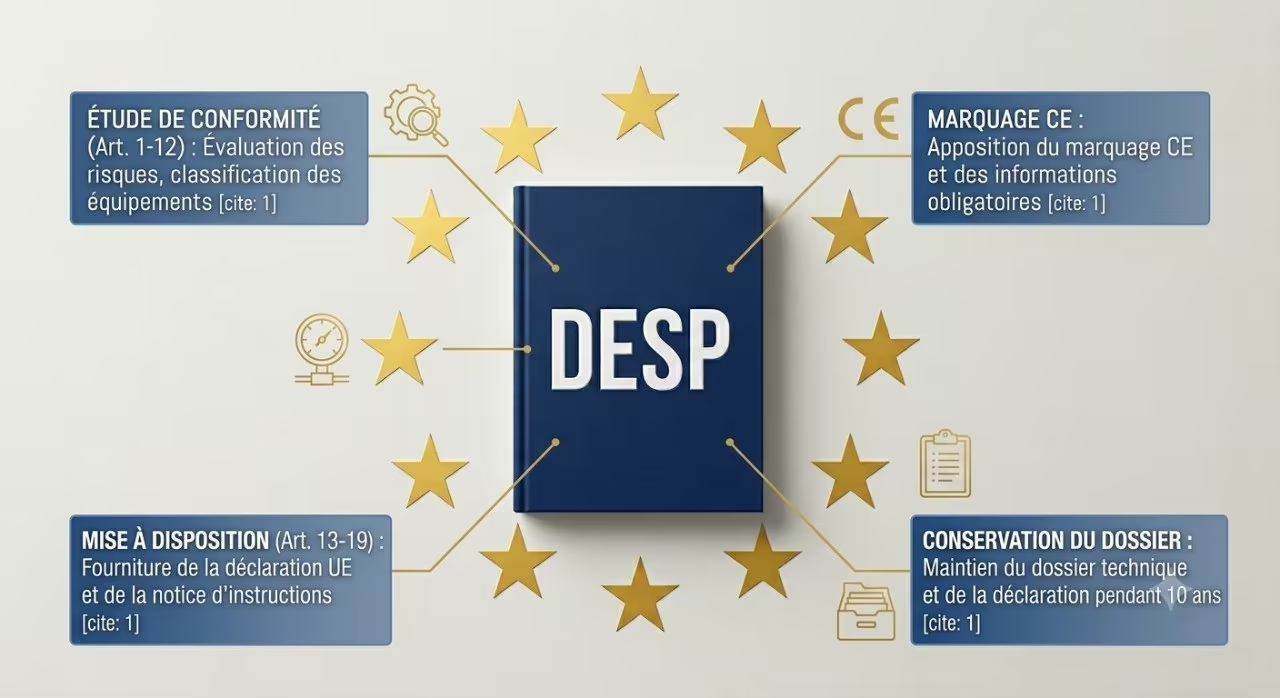
Which companies are affected?
The DESP applies to any company that uses, manufactures, installs, or distributes pressure equipment. The most affected sectors are:
- Food industry: steam boilers for sterilisation, refrigerant fluid tanks, industrial refrigeration installations
- Chemical and pharmaceutical industry: pressure reactors, storage tanks, piping networks transporting hazardous fluids
- Oil and gas industry: separators, compressors, pressurised storage
- HVAC and building services: boilers, hot water tanks, heat pumps, heating networks
- Industrial and commercial refrigeration: compressors, condensers, evaporators, refrigerant liquid tanks
- Mechanical engineering and metallurgy: compressed air tanks, pneumatic networks, production boilers
- Commercial and collective catering: industrial pressure cookers, pressure fryers, kitchen boilers
DESP applicability criteria
Equipment falls under the DESP as soon as:
- Its maximum allowable pressure (PS) exceeds 0.5 bar
- Its volume or nominal size exceeds the thresholds of Annex II
- It contains a group 1 fluid (toxic, flammable, corrosive) or group 2 fluid (other fluids)
Categories range from I to IV. The higher the category, the stricter the conformity and control requirements.
Legal obligations of companies
1. Obligations of the manufacturer or importer
Any company that manufactures or imports pressure equipment for the European market must:
- Carry out a conformity assessment according to the DESP modules (A, B, C, D, E, F, G, H)
- Appoint a notified body for categories III and IV
- Draw up an EU declaration of conformity
- Compile a technical file (design, calculations, materials, tests)
- Affix the CE marking on the equipment
- Provide installation and maintenance instructions in French
2. Obligations of the operator (arrêté du 20 novembre 2017)
The operating company, even if it did not manufacture the equipment, is responsible for its safety in service. It must:
a) Compile and keep up to date an equipment file
- Original plans and subsequent modifications
- Material certificates and test reports
- Commissioning reports and service entry reports
- Maintenance register and maintenance sheets
- Reports of inspection visits and reinforced inspections
b) Appoint an operations manager
- Competent person, trained in DESP regulations
- With the necessary authority to enforce safety instructions
- Available in case of emergency
c) Carry out periodic inspections with an accredited body
- Inspection visit: frequency according to category (1 to 3 years)
- Reinforced inspection: non-destructive testing (3 to 10 years)
- Re-examination: in-depth inspection with pressure test (10 to 20 years)
d) Ensure preventive maintenance
- Regular inspection of safety devices (valves, rupture discs)
- Checking of supports, anchors, and fixing devices
- Inspection of measuring devices (pressure gauges, thermometers, levels)
- Maintenance of detection and alarm systems
e) Train personnel
- Operating personnel: training in handling, emergency procedures
- Maintenance personnel: training in authorised and prohibited interventions
- All personnel: awareness of risks and evacuation instructions
f) Report accidents and incidents
- Declaration to the labour inspectorate in the event of a serious accident or incident
- Preservation of material evidence until the inspector authorises its removal
- Entry in the maintenance register
Inspections and periodic controls
Who carries out the inspections?
Accredited bodies carry out all periodic inspections of equipment in service. They are approved by the competent French authority. Notified bodies are only involved in the manufacture and initial conformity assessment.
Types of controls
| Type of control | Content | Indicative frequency |
|---|---|---|
| Inspection visit | Visual inspection, safety device operation, supports, maintenance file | 1 to 3 years (depending on category) |
| Reinforced inspection | + Non-destructive testing (ultrasonics, magnetic particle inspection, radiography) | 3 to 10 years |
| Re-examination | + Partial dismantling, pressure test, resistance calculation | 10 to 20 years |
Exact frequency
The actual frequency is set by the accredited body in its inspection report, depending on:
- The category of the equipment (I to IV)
- The nature of the fluid (group 1 or 2)
- The operating conditions (temperature, cycling, corrosion)
- The maintenance history and the results of previous controls
Sanctions in case of non-compliance
Administrative sanctions
- Formal notice by the labour inspectorate with a compliance deadline
- Prohibition order on the operation of the equipment or installation
- Administrative fine of up to €15,000 for a natural person, €75,000 for a legal entity
- Publication of the sanction on the labour inspectorate website
Criminal penalties
- 4th class fine (up to €3,750) for breach of the arrêté du 20 novembre 2017
- 5th class fine (up to €7,500) in case of repeat offence or serious danger
- Imprisonment of 1 year and a fine of €15,000 in case of involuntary injury
- Imprisonment of 3 years and a fine of €45,000 in case of involuntary manslaughter
- Criminal liability of the manager (Article 121-3 of the French Criminal Code: deliberate endangerment of others)
Civil liability
- Operator’s liability in the event of an accident caused by a maintenance or inspection defect
- Liability for defective products (manufacturer, importer, distributor)
- Compensation action by victims or beneficiaries
- Loss of insurance cover if non-compliance is proven
Economic consequences
- Production stoppage and loss of turnover
- Cost of bringing back into compliance (inspections, repairs, replacement)
- Loss of certification or quality label (ISO 9001, IFS, BRC)
- Reputational damage and loss of customers
Common company errors
1. Not identifying all affected equipment
The company thinks that only boilers or large tanks are subject to the DESP. It forgets oil separators, heat exchangers, discharge piping, and safety devices. Result: part of the installation is not inspected and exposes the company to a formal notice.
2. Confusing a notified body with an accredited body
The company calls on a notified body for periodic inspections. However, notified bodies are involved in manufacture. Inspections in service must be carried out by accredited bodies. The inspection report may be invalidated and the labour inspectorate may refuse proof of compliance.
3. Leaving the equipment file incomplete
The equipment file is scattered between several departments, lost during a move, or never reconstituted after the purchase of second-hand equipment. In the event of an inspection, the company cannot prove the compliance of its equipment. The inspector may order a shutdown of operation until the file is reconstituted.
4. Outsourcing maintenance without oversight
The company entrusts maintenance to an external contractor but does not check that the latter carries out interventions in accordance with the arrêté du 20 novembre 2017. The intervention sheets are vague, the safety devices are not inspected, and anomalies are not reported. The liability remains entirely with the operator.
5. Ignoring modified or repaired equipment
After a major modification or repair, the company does not have a new initial inspection carried out. The modification may change the category of the equipment, affect its resistance, or render the initial CE marking non-compliant. The modified equipment must be re-evaluated and brought back into compliance.
Industrial case: food processing company
Context
Meat processing company, 150 employees, site with 3 steam boilers of 5 tonnes/hour, 2 ammonia refrigeration installations, compressed air network with 3 tanks.
Identified pressure equipment
- 3 steam boilers (category III, group 2 fluid)
- 2 refrigeration compressors with liquid tanks (category III, group 1 fluid ammonia)
- 6 oil separators and heat exchangers (category II)
- 3 compressed air tanks of 500 L (category II)
- Steam, ammonia, and compressed air piping (category I to III depending on DN and PS)
- 12 safety valves, 3 rupture discs, pressure gauges, and thermometers
Compliance process
- Compilation of the equipment file: reconstitution from original plans, material certificates, boiler test reports
- Accredited body: annual inspection visit contract for boilers and ammonia, reinforced inspection every 3 years
- Operations manager: appointment of a trained workshop manager, authorisation for boiler operation
- Maintenance register: monthly inspection sheets for valves, levels, ammonia leak detectors
- Training: awareness of 150 employees on risks, training of 8 operators on operation and emergency procedures
Result
- Full compliance achieved in 4 months
- 0 formal notices during the next labour inspection
- 30% reduction in production stoppages thanks to preventive maintenance
- IFS Food certification renewed without observation
FAQ: DESP regulation and company obligations
What is the difference between the DESP and the arrêté du 20 novembre 2017?
The DESP (2014/68/EU) is the European directive that regulates the design and manufacture of pressure equipment. The arrêté du 20 novembre 2017 is the French transposition that imposes the rules for the operation, maintenance, and periodic inspection of equipment in service. The DESP concerns the manufacturer; the arrêté concerns the operator.
What is the difference between a notified body and an accredited body?
A notified body is approved by an EU Member State to assess the conformity of equipment during its manufacture (categories III and IV). An accredited body is approved by the French authority to carry out periodic inspections of equipment in service (all categories). The two roles are distinct and complementary.
What is the frequency of DESP inspections?
The frequency depends on the category of the equipment and its use. For a category III equipment, the inspection visit is generally annual, the reinforced inspection every 3 years, and the re-examination every 10 years. For a category II equipment, the frequencies are longer. Only the accredited body sets the exact frequency in the inspection report.
What are the sanctions if my company is not compliant?
Sanctions range from formal notice to shutdown of operation, including administrative fines (up to €75,000 for a legal entity). In the event of an accident, the operator faces criminal penalties: fine up to €45,000 and imprisonment up to 3 years in case of involuntary manslaughter. The manager may be personally prosecuted.
My company bought second-hand equipment without a CE marking. What should I do?
Equipment put into service before 1997 (DESP 97/23/EC) or 2016 (DESP 2014/68/EU) may remain in service without a CE marking if it complied with the applicable regulations at the time. However, you must comply with the arrêté du 20 novembre 2017 (inspections, maintenance, file). If the file is incomplete, an accredited body can establish a conformity re-assessment. New or majorly repaired equipment must bear the CE marking.
Summary
The DESP regulation (2014/68/EU) imposes a strict safety framework on industrial companies for pressure equipment. The company must identify all its affected equipment, compile a complete equipment file, appoint a competent operations manager, and have periodic inspections carried out by an accredited body. The arrêté du 20 novembre 2017 frames these obligations in France. The sanctions for non-compliance are severe: administrative (formal notice, fine), criminal (imprisonment in the event of an accident), and civil (operator’s liability). Common errors — incomplete identification, confusion between notified body and accredited body, scattered file, outsourced maintenance without oversight, forgetting modifications — can be avoided through rigorous organisation and active regulatory monitoring. A compliant company protects its employees, its installations, and its economic sustainability.