



PED Regulation (Manufacturing) & Professional Technical File (PTP)
Purpose of the regulation
The PED 2014/68/EU Directive
Directive 2014/68/EU aims to regulate the placing on the market of refrigeration pressure equipment that may present a risk to property and persons. The objective is to establish common European requirements for the control of risks related to pressure equipment.
The Professional Technical File (PTP)
As for the Professional Technical File (PTP), it aims to regulate the regulatory monitoring during the operation of the refrigeration or air conditioning installation.
There are several Professional Technical Files (PTP) for several fields. In the context of a refrigeration or air conditioning installation, we are referring to the Refrigeration PTP.
PE monitoring, for what? For whom?
This regulation applies to all refrigeration pressure equipment:
- Vessels
- Piping
- Heat exchangers
- Thermal compressors
- Safety accessories
- Etc.
And to assemblies whose working pressure PS is greater than 4 bars.
Concerned installations
Refrigeration installations may be subject to the monitoring of pressure equipment (PE) as soon as they are identified as category II or higher.
Equipment of category I & Article 4.3 (Sound engineering practice) are excluded from this regulatory monitoring.
Affected stakeholders
The pressure equipment directive affects all stakeholders in the professional sector:
- Manufacturers
- Distributors
- Operators
- Maintenance providers
- Users
Note: The term “PED” is often incorrectly used to designate in-service monitoring. The correct term for monitoring is “PE” (Pressure Equipment) or “PTP” (Professional Technical File).
How do I know if my refrigeration installation is concerned?
To determine if your refrigeration installation is subject to in-service monitoring under the Professional Technical File (PTP), you need to identify:
- The refrigerant to define the classification (Group 1 or Group 2)
- The Working Pressure (PS)
- The volume (V) for each vessel concerned
- The Nominal Diameters (DN) and the Working Pressure (PS) for piping
Role and responsibilities of stakeholders in the sector
The operator (Order of November 20, 2017)
or PTP relating to the monitoring of pressurized refrigeration systems:
- Installs the equipment in compliance with the manufacturer’s instruction manuals in French and conformity declarations
- Keeps the necessary documents and makes them available in the regulatory file
- Establishes an article 6.3 list (Order of 11/20/2017)
- Defines an inspection plan for monitoring their equipment (Approval by an Authorized Body (AB) at the latest before the first periodic requalification)
- Conducts an initial visit and a periodic inspection at each regulatory deadline:
- Maximum 48 months for category II or III PE
- Generally 24 months for category IV PE
- Calls upon an Authorized Body (AB) every 6 to 12 years for a Periodic Requalification
The manufacturer (Directive 2014/68/EU)
- Ensures the conformity of their equipment with European regulations (CE marking)
- Archives all technical documentation for a minimum period of 10 years after the date of placing on the market
- Makes available to its customers the PED/PED list of equipment concerned by the PED
Definitions:
- PED: Pressure Equipment Directive
- PED: Directive des Équipements Sous Pression
Regulatory File / PED File
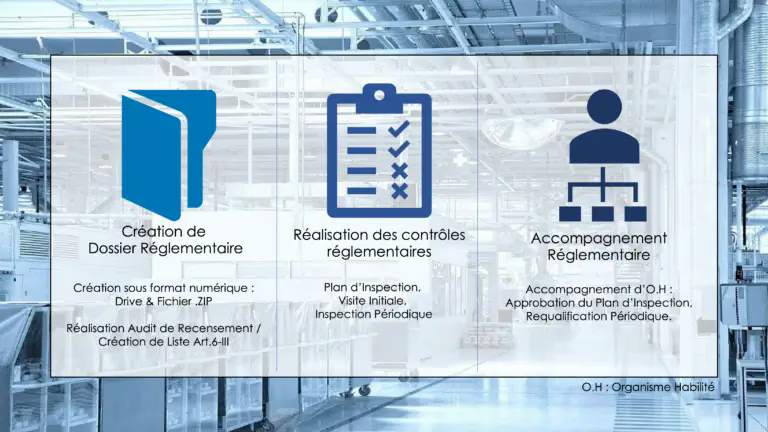
The operator must open and complete an operating file for the refrigeration system comprising equipment monitored according to the Professional Technical File.
Required documents
1. Conformity declarations
- A conformity declaration to CE directive 97/23 or 2014/68/EU for the assembly for each refrigerant group established by the manufacturer
- In case of absence: conformity declaration for each component constituting the refrigeration unit (exchanger, bottle, separator, etc.)
2. Instruction manuals
- The instruction manual for the assembly, written in French
- The instruction manuals for each safety accessory, written in French
3. List of equipment subject to the order of November 20, 2017 Reproduces the provisions of article 6-3 of this order, indicating for each piece of equipment:
- The type
- The manufacturer
- The PS
- The volume
- The monitoring regime
- The dates of completion of the last and next inspection
- The dates of the last and next periodic requalification
4. Operating incident records (If applicable)
5. Repair or modification records (If applicable)
6. Intervention records
- Interventions requiring opening of the refrigeration circuit
- Results of checks carried out (If applicable)
7. Inspection reports
- Report of the initial verification before first commissioning (if applicable)
- Periodic inspection reports (if applicable)
- Last requalification certificate (if applicable)
- Documentation relating to monitoring with inspection plan
8. Refrigeration schematic or synoptic diagram For example P&ID (Piping and Instrumentation Diagram) of the pressurized refrigeration system giving all the information and markings necessary and useful for operating controls.
9. List of safety accessories Manufacturer, brand, model, setting…
10. Valve conformity declarations
- Conformity declaration to CE directive 97/23 or 2014/68/EU for safety valves
- Setting certificate
11. Sizing justification Justification for the sizing and adequacy of all safety accessories in relation to the protected vessel (calculation note for example).
Exception: For “horse head” vessels or vessels delivered by the manufacturer with their safety accessories, this justification is not required if the safety accessories are original, identical to the original or provide at least equivalent protection.
12. Valve resetting For a periodic requalification, the resetting of safety valves or their replacement by a safety accessory providing the same protection is required during inspections or periodic requalifications.
Provide a certificate of absence of non-condensable gases by the refrigeration technician or any other authorized person.
13. Identification marks If the identification marks (marking or CE labeling) are likely to be erased or are hidden (under insulation, hidden by other elements), the operator ensures, under the supervision of the authorized person, the transfer of part of the marks from the elements of the descriptive file or any element of proof.
The marks to be transferred at a minimum are:
- The name and address or another means of identification of the manufacturer and, where applicable, of his agent established in the European Community
- The year of manufacture
- The identification of the vessel according to its nature (type, series or batch identification, manufacturing number)
- The PS pressure, its volume and the min/max TS temperatures
- The hydraulic test pressure of the final examination (mandatory for equipment monitored according to the provisions of chapter B)
14. Commissioning declaration For refrigeration units composed of vessels whose product of pressure multiplied by volume (P × V) is greater than 10,000 bar.liter, the receipt of the commissioning declaration as pressure equipment must be presented.
The declaration is made via the administration’s website: https://lune.din.developpement-durable.gouv.fr/externe/Accueil.do
15. List of authorized personnel For these vessels, the list of personnel authorized by the operator in charge of operating the refrigeration unit must also be presented.
16. Presence of the refrigeration technician A refrigeration technician must be present on site to:
- Locate and/or carry out, in the presence of an Authorized Body (AB), the tripping tests of safety pressure switches during periodic requalifications
- Answer questions concerning the refrigeration unit
- Make accessible certain parts of components, such as nameplates that would be under insulation
Additional resources
Watch our presentation video of the cPED tool
Source: The DCRR team