



DESP (2014/68/EU): regulation of pressure equipment
The DESP Directive (2014/68/EU) is the European regulatory framework that imposes design, manufacturing and control rules on pressure equipment. It aims to ensure the safety of people and property against the risks of explosion, leakage or rupture. Any operator of an industrial installation — refrigeration, HVAC, boiler, pressure vessel — must know its scope of application and its compliance obligations.
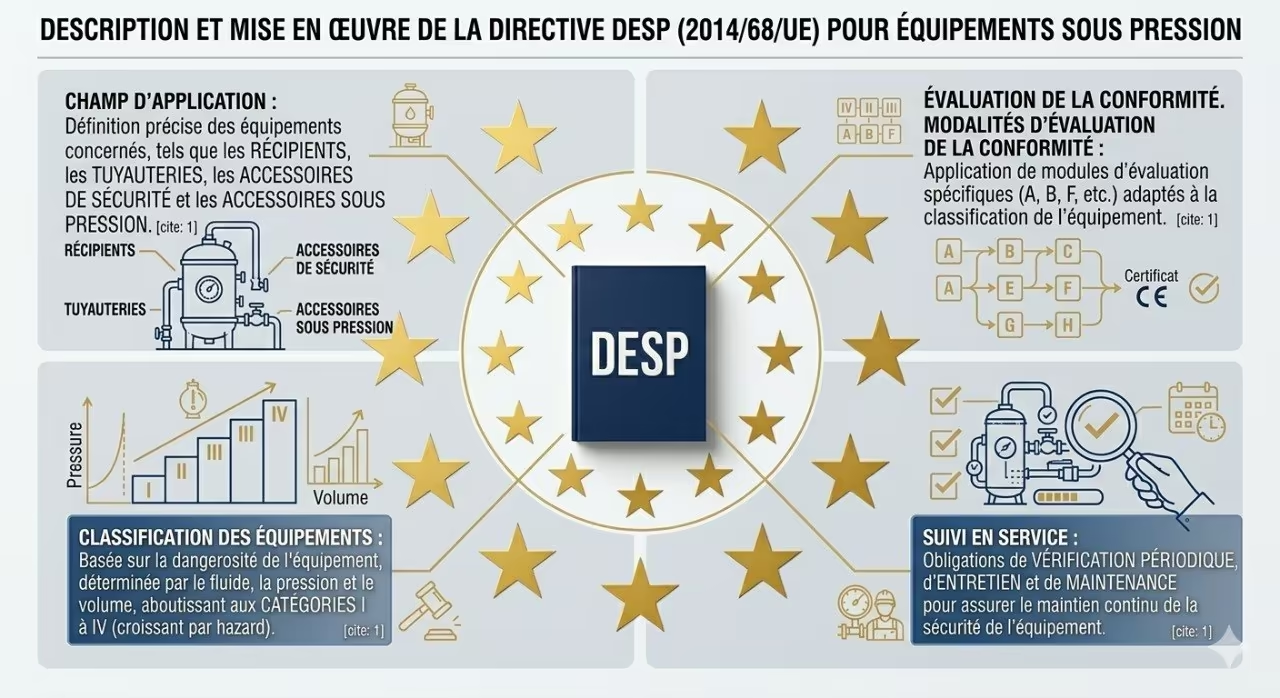
Which equipment falls under the DESP?
The DESP applies to pressure equipment whose maximum allowable pressure (PS) exceeds 0.5 bar and whose volume or nominal dimension exceeds certain thresholds defined in Annex II. This concerns:
- Pressure vessels: tanks, vessels, separators, compressed air receivers
- Steam and superheated water boilers
- Piping: pipelines transporting fluids under pressure (gas, steam, liquids)
- Safety devices: safety valves, rupture discs, fusible plugs
- Refrigeration equipment: compressors, condensers, evaporators, refrigerant liquid receivers under pressure
- Pressure accessories: valves, fittings, gaskets, flanges, pressure measuring instruments
Important exclusions
Certain equipment is exempt from the DESP, notably:
- Gas fuel distribution networks (specific regulation)
- Nuclear equipment subject to authorisation
- Transportable gas cylinders (ADR/TPED regulation)
- Low-pressure or small-volume equipment below the thresholds of Annex II
- Equipment intended exclusively for military use
Annex II thresholds
The DESP distinguishes several categories according to the pressure/volume combination (or nominal dimension for piping) and the nature of the fluid (group 1: hazardous; group 2: others). Categories range from I to IV, category IV imposing the strictest requirements. A vessel containing a group 1 fluid with PS > 200 bar and V > 0.1 L, or PS.V > 5000 bar.L, falls into category IV.
Obligations of the operator and the manufacturer
CE marking and conformity assessment (manufacturing)
Any pressure equipment placed on the European market must bear the CE marking. The conformity assessment varies according to the category:
- Categories I and II: self-certification procedure or limited notified body control
- Categories III and IV: mandatory intervention of a notified body (module B + C2, D, E, F, G or H as applicable)
The manufacturer must establish:
- An EU declaration of conformity
- A technical file (design, calculations, materials, tests)
- Installation and maintenance instructions
- A CE marking accompanied by the number of the notified body (for categories III and IV)
Key point: Notified bodies intervene on manufacturing and placing on the market. They do not carry out periodic inspections of equipment in service.
Operator obligations in service
The operator of pressure equipment in service is not relieved of responsibility by the initial CE marking. They must:
- Comply with the provisions of the French decree of 20 November 2017 relating to the commissioning and operation of pressure equipment
- Constitute and keep up to date an equipment file comprising plans, material certificates, inspection reports, maintenance sheets
- Appoint a competent and trained operation manager
- Carry out periodic inspections provided for by the regulations with an accredited body
- Report without delay to the labour inspectorate any serious accident or incident
Inspections and periodic controls
Types of controls carried out by accredited bodies
The French regulation imposes several types of periodic controls, carried out by accredited bodies (and not notified bodies). The periodicity depends on the category of the equipment and its use:
1. Initial verification before commissioning
- Acceptance of new works or major repairs
- Verification of compliance with the regulations in force
- Control of safety devices (valves, rupture discs)
- Pressure resistance test (hydraulic or pneumatic) if necessary
2. Periodic controls in service
- Inspection visit: visual inspection, verification of the functioning of safety devices, control of supports and anchors, examination of maintenance records. Periodicity: generally 1 to 3 years depending on the category and use.
- Reinforced inspection visit: includes non-destructive testing (radiography, ultrasound, magnetic particle inspection) to detect internal defects. Periodicity: 3 to 10 years depending on the category.
- Re-examination: in-depth inspection with partial dismantling, pressure test, deformation analysis. Periodicity: 10 to 20 years.
Who carries out the inspections?
- Accredited bodies carry out all periodic inspections of equipment in service (categories I to IV)
- Notified bodies intervene only on manufacturing, design and initial conformity assessment (categories III and IV)
- Labour inspectorate services can check at any time the respect of regulatory obligations
Documentation to present
During an inspection, the operator must be able to present:
- The equipment file (plans, certificates, test reports)
- The maintenance register and maintenance sheets
- The reports of previous inspection visits
- The acceptance report or recommissioning report
- The competence certificates of the operating personnel
Industrial risks related to pressure equipment
Explosion and sudden rupture
Excess pressure, stress corrosion cracking, material fatigue or a manufacturing defect can cause the rupture of a vessel or pipeline. The explosion of pressure equipment containing a gas or steam generates a shock wave capable of destroying buildings and killing people several tens of metres away. Projected debris constitutes an additional danger.
Leakage of hazardous fluid
Pressure equipment containing a toxic, corrosive or flammable fluid (group 1) represents a major chemical risk. A leak under pressure can create a toxic cloud, cause a fire or a secondary explosion. Ammonia (R717) refrigerants and certain HFCs present risks of asphyxiation or toxicity in case of significant spillage.
Burns and projection
Pressure equipment containing superheated water or high-temperature steam presents a risk of serious burns in case of rupture or untimely opening. The sudden expansion of a liquid under pressure can cause violent projection and contact burns.
Documented accident cases
- Boiler explosion (2019, food processing plant): rupture of a steam boiler tube due to corrosion-erosion. One operator killed, production stopped for 6 months.
- Ammonia leak (2021, cold storage warehouse): rupture of a compressor discharge pipeline due to poorly controlled vibration. Evacuation of 200 people, hospitalisation of 3 operators.
- Compressed air receiver rupture (2020, mechanical workshop): receiver not inspected for 15 years, internal corrosion not detected. Explosion during charging, destruction of the premises, no casualties (fortunately the premises were unoccupied).
Common mistakes on the ground
1. Confusion between DESP and refrigerant fluid regulation
Many operators think that the only regulation applicable to their refrigeration installation is that of refrigerant fluids (F-Gas Regulation, Regulation EC 1005/2009). However, pressure refrigeration equipment (compressors, liquid receivers, exchangers) also falls under the DESP as soon as they exceed the pressure/volume thresholds. The absence of a DESP file and periodic inspection visits is a frequent offence.
2. Confusion between notified body and accredited body
A classic mistake is to ask a notified body to carry out a periodic inspection in service. Notified bodies intervene on manufacturing and initial conformity assessment. Periodic inspections of equipment in service must be carried out by accredited bodies. Mixing the two delays procedures and can invalidate inspection reports.
3. Forgetting safety devices in compliance
Safety valves, rupture discs and fusible plugs are DESP equipment in their own right. They must be sized, installed and maintained in accordance with the regulations. A common mistake is to replace a valve with a non-compliant model or not to check its sealing and triggering.
4. Maintenance reduced to the strict minimum
The French decree of 20 November 2017 requires regular maintenance including the control of safety devices, the verification of supports and anchors, the control of measuring devices. In the field, maintenance is often limited to fluid filling and breakdown repair, without structured preventive maintenance.
5. Absence of up-to-date equipment file
The equipment file is the reference document for any inspection. It must contain the original plans, material certificates, test reports, acceptance reports, inspection visit reports. In practice, this file is often incomplete, scattered, or lost during a change of operator or installer.
6. Underestimating “modest” equipment
A small oil separator, a refrigerant liquid receiver of a few litres, a discharge pipeline: this equipment may seem harmless but falls under the DESP as soon as it exceeds the thresholds. Their exclusion from the inspection plan exposes the operator to a formal notice and an accident risk.
Field case: 500 kW refrigeration installation
Context
Frozen product storage warehouse, ammonia refrigeration installation (R717), two screw compressors, evaporative condenser, two flooded evaporators, liquid and recycling receivers.
Pressure equipment identified
- 2 screw compressors (discharge pressure casing)
- 2 oil separators (PS = 18 bar, V = 25 L each)
- 1 main liquid receiver (PS = 18 bar, V = 200 L)
- 1 recycling receiver (PS = 18 bar, V = 50 L)
- Discharge and suction piping (DN > 25 mm)
- 4 safety valves on receivers and separators
- 1 rupture disc on the main receiver
DESP compliance
- Equipment category: II and III depending on the fluid (ammonia = group 1) and the PS.V characteristics
- Accredited body for periodic inspections: annual inspection visit for ammonia, reinforced inspection every 3 years
- Equipment file reconstructed from original plans and material certificates
- Implementation of a maintenance register with monthly sheets for valve and oil level checks
- Training of operating personnel in leak detection and emergency procedures
Specific points of vigilance
- External corrosion of receivers (humid atmosphere, presence of ammonia in case of micro-leak)
- Vibrations on discharge pipelines (risk of cracking by fatigue)
- Condition of joints and flanges on ammonia lines
- Annual calibration of fixed and portable leak detectors
FAQ: DESP (2014/68/EU)
What is the difference between the DESP and the French decree of 20 November 2017?
The DESP (2014/68/EU) is the European directive that applies to the design, manufacturing and placing on the market of pressure equipment. The French decree of 20 November 2017 is the French transposition that imposes rules for the operation, maintenance and periodic control of equipment already in service. The DESP concerns the manufacturer; the decree concerns the operator.
What is the difference between a notified body and an accredited body?
A notified body is accredited by an EU Member State to assess the conformity of equipment during manufacturing (categories III and IV). It intervenes on design, tests and CE marking. An accredited body is accredited by the French authority to carry out periodic inspections of equipment in service (inspection visits, reinforced inspections, re-examinations). The two roles are distinct and complementary.
Are all refrigeration compressors subject to the DESP?
No. A hermetic or semi-hermetic compressor of low power, with a small-volume casing and limited discharge pressure, may be below the thresholds of Annex II. However, industrial compressors, refrigerant liquid receivers and discharge piping generally exceed the thresholds and fall under the DESP.
What is the periodicity of DESP inspections?
The periodicity depends on the category of the equipment and its use. For a category III equipment, the inspection visit is generally annual, the reinforced inspection every 3 years, and the re-examination every 10 years. For a category II equipment, the periodicities are extended (inspection visit every 2 to 3 years). Only the accredited body can set the exact periodicity in the inspection report.
Can equipment without CE marking remain in service?
Equipment put into service before the entry into force of the directive (before 1997 for DESP 97/23/EC, before 2016 for 2014/68/EU) can remain in service if it complied with the regulations applicable at the time of its commissioning. However, the operator must always comply with the French decree of 20 November 2017 (inspection visits, maintenance, equipment file). New or majorly repaired equipment must bear the CE marking.
What to do if the equipment file is incomplete or lost?
The operator must reconstruct the file as far as possible: original plans from the manufacturer or installer, material certificates, test reports. If documents are irretrievably missing, an accredited body can establish a “conformity reassessment” file from an in-depth inspection, non-destructive tests and a resistance calculation. This procedure is more complex and costly but allows the situation to be regularised.
Summary
The DESP (2014/68/EU) governs the safety of pressure equipment in Europe, from design to operation. It applies to vessels, boilers, piping and safety devices exceeding the pressure and volume thresholds. The operator must comply with the French decree of 20 November 2017: keep an equipment file, carry out periodic inspections with an accredited body, maintain safety devices and train personnel. Notified bodies intervene only on manufacturing and CE marking. The risks — explosion, leakage of hazardous fluid, burns — are real and documented. Common mistakes in the field (confusion between notified/accredited bodies, forgetting small equipment, incomplete file, insufficient maintenance) expose operators to sanctions and avoidable accidents. Good mastery of the DESP requires the exhaustive identification of concerned equipment, the clear distinction between the roles of the manufacturer and the operator, and the rigorous planning of inspections with an accredited body.