


Evolution of ESP Refrigeration Tracking Regulations – CTP 2026 vs 2020: Everything That Changes
Introduction
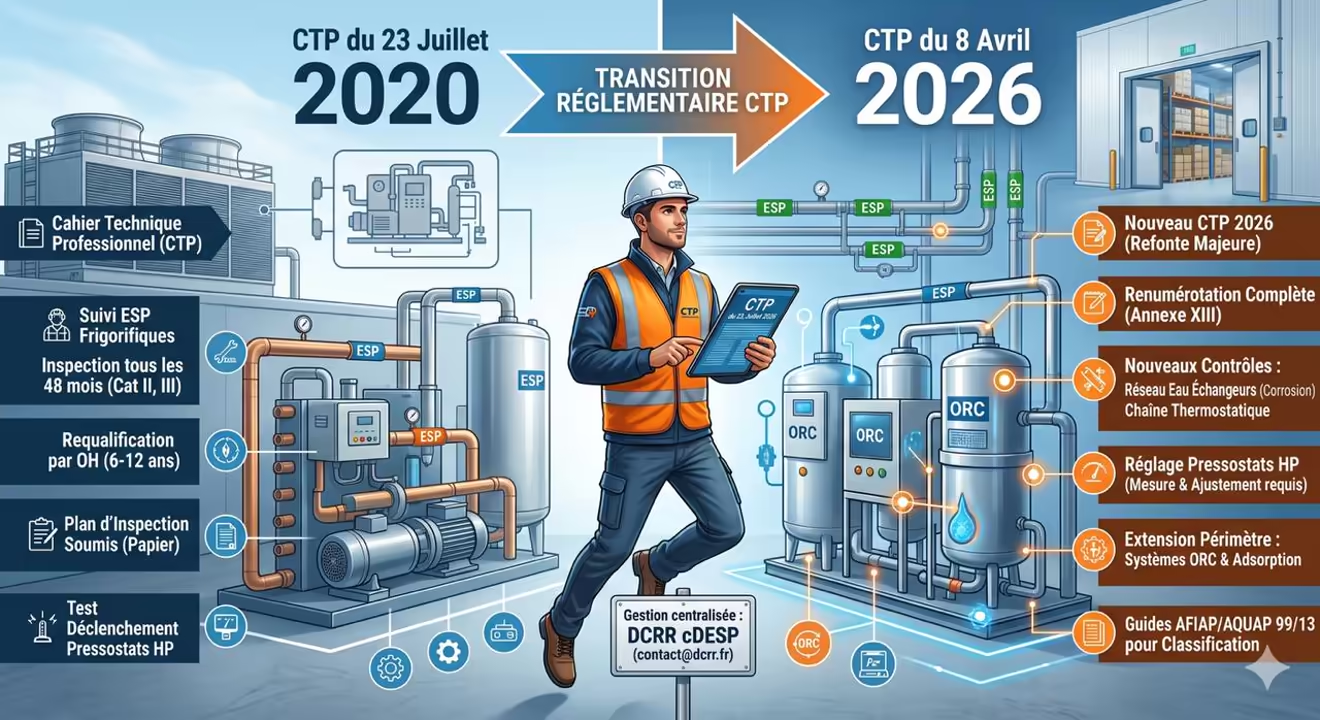
The Professional Technical Booklet on in-service monitoring of refrigeration pressure systems is undergoing a major overhaul this spring 2026. Adopted by BSERR Decision No. 2026-002 dated 17 April 2026, the new version of the document — finalized on 8 April 2026 — substantially modifies the framework for regulatory monitoring of Pressure Equipment (ESP) constituting refrigeration installations.
Led by La Chaîne Logistique du Froid and long awaited by all industry stakeholders — operators, maintainers, authorized bodies, engineering firms — this revision is not merely an administrative update. It directly impacts the structure of the inspection plan, the regime for high-pressure pressure switches, the nature of required controls, and the documents to be produced.
This article analyzes point by point the changes introduced by CTP 2026 compared to the CTP of 23 July 2020, and outlines the operational consequences for professionals.
1. Reminder: Purpose and Scope of the Refrigeration CTP
The Professional Technical Booklet is the reference document governing the in-service monitoring of pressure equipment in refrigeration systems: vessels, piping, heat exchangers, safety accessories, thermal compressors, etc.
It applies to any installation whose operating pressure (PS) exceeds 4 bar and is classified in Category II or higher under Directive 2014/68/EU known as the “Pressure Equipment Directive” (PED). Equipment in Category I or under Article 4.3 (sound engineering practice) is excluded from regulatory monitoring.
The CTP defines:
- Operator obligations: establishment and maintenance of the operating file, drafting of the inspection plan;
- Regulatory frequencies: periodic inspection (PI), periodic requalification (PR);
- Respective responsibilities of the operator, manufacturer, maintainer, and Authorized Body (AB);
- Nature of documents to be produced and retained.
The document was designed to be self-contained: its application should enable any professional to fully comply without referring to other texts.
2. The CTP of 23 July 2020: Foundations and Limitations
Adopted by BSERR decision of 19 August 2020, the CTP of 23 July 2020 was the culmination of two years of work by an interprofessional group involving AFG, EDF, Fedene, France Chimie, Engie, GRDF, Perifem, Snefcca, USNEF, Uniclima, and several other organizations.
It pursued four objectives:
- Regulatory compliance by alignment with the decree of 20 November 2017;
- Simplification through the production of a single document replacing a scattered corpus of texts;
- Capitalization of feedback from professional practice;
- Education by clarifying whether routine interventions are notable or not.
The 2020 CTP notably established:
- A periodic inspection every 48 months for Category II and III ESP, every 24 months for Category IV;
- A periodic requalification by an AB every 6 to 12 years depending on category;
- The operator’s obligation to establish an inspection plan submitted for AB approval prior to the first PR;
- An operating file comprising 16 categories of documents.
While this framework proved robust, its application revealed certain limitations, particularly regarding the rigidity of a uniform approach and exclusively paper-based documentation. La RPF announced as early as 11 December 2025 that two major developments were in preparation.
3. CTP of 8 April 2026: Analysis of Changes
3.1 Restructuring of the Inspection Plan
The first structural change concerns the organization of the document. The operating file and inspection plan — which appeared in sections A.7 and A.8 of the 2020 CTP — are now placed in sections A.1 and A.2.
All paragraphs have been renumbered. To establish correspondence between the two versions and ensure continuity of existing inspection plans, CTP 2026 introduces an Annex XIII specifically dedicated to this transposition table.
3.2 New Mandatory Controls
CTP 2026 introduces several control points that were not required in the previous version:
- Secondary hydraulic network control for heat exchangers: periodic inspection must now include a check of the water-side corrosion condition of heat exchangers. This provision concerns all installations equipped with water-cooled condensers.
- High-temperature thermostat safety chain verification: section E.13 introduces a requirement to check the integrity of the entire thermostat safety chain, beyond the simple trip test.
- Completeness audit of controls during requalification: section A.5.3.3 requires that the authorized body verify, during each periodic requalification, that all controls provided for in the inspection plan have actually been carried out.
3.3 High-Pressure Pressure Switch Regime
This change is one of the most impactful for intervention personnel:
The qualification of the operation evolves: “test” becomes “setting.” It is no longer sufficient to observe the pressure switch trip; the operator must now measure the trip point value and adjust it if necessary. This requirement involves the use of appropriate measuring instruments and requires specific personnel competence.
At the same time, certain pressure switches are excluded from the scope of the inspection plan (section E.12.3):
- Pressure switches specific to compressors;
- Pressure switches protecting no equipment subject to ESP monitoring;
- Pressure switches duplicating a safety valve.
3.4 Classification of Interventions
Technical sheets No. 8, 9, and 11 of the 2020 CTP, which established the classification of interventions into “notable” and “non-notable,” are repealed.
Intervention classification is now delegated to the relevant professional guides:
- The AFIAP guide (French Association of Pressure Vessel Engineers);
- The AQUAP 99/13 guide.
3.5 New Annexes
Two annexes appear in CTP 2026:
- Annex X: model for inspection plan approval request by the AB. This document formalizes the operator’s commitments regarding regulatory monitoring, control scheduling, and annual feedback reporting. The AB’s approval deadline may not exceed three months.
- Annex XIII: comprehensive correspondence table between the numbering of the 2020 CTP and that of the 2026 CTP.
3.6 Extension of Scope
The scope of CTP 2026 is extended to two new equipment families:
- ORC (Organic Rankine Cycle) systems;
- Adsorption refrigeration machines (the 2020 CTP only covered absorption machines).
3.7 Repealed Provisions
- The section on “Persons qualified to operate” is removed: the corresponding provisions now fall directly under the ministerial decree of 20 November 2017.
- The diagrams and tables for classifying interventions (technical sheets No. 8, 9, and 11) are removed.
4. Comparative Summary Table
| Provision | CTP 2020 | CTP 2026 |
|---|---|---|
| Reference | BSERR of 19 August 2020 | BSERR No. 2026-002 of 17 April 2026 |
| Inspection plan | Sections A.7 and A.8 | Sections A.1 and A.2 (complete renumbering) |
| HP pressure switches | Trip test | Setting with measurement of trip point |
| Excluded pressure switches | No formal exclusion | Exclusion E.12.3 (compressors, outside ESP scope, duplicated with valve) |
| Additional controls | Not specified | Heat exchanger corrosion (E.13), thermostat chain, complete PI audit (A.5.3.3) |
| Intervention classification | Technical sheets No. 8, 9, 11 | AFIAP and AQUAP 99/13 guides |
| PI approval request | No formalism required | Annex X (formalized commitment, 3-month deadline) |
| Numbering correspondence | Not applicable | Annex XIII (2020→2026 transposition table) |
| Scope | Absorption systems | Added ORC + adsorption |
| Qualified persons | Dedicated section | Repealed (referral to AM of 20/11/2017) |
| Governance | USNEF interprofessional group | La Chaîne Logistique du Froid + BSERR |
5. Operational Consequences
5.1 For Operators
Compliance with CTP 2026 entails the following obligations:
- Update and re-approval of the inspection plan within three months of submission to the AB, via the Annex X formalism. The general renumbering requires the use of Annex XIII.
- Integration of new control points into the periodic inspection program: water-side corrosion of heat exchangers, complete thermostat safety chain.
- Justification of control completeness during the next periodic requalification (A.5.3.3).
- Adoption of AFIAP and AQUAP 99/13 guides in place of the repealed technical sheets.
The cDESP solution from DCRR enables centralized management of these obligations: automatic numbering transposition via Annex XIII, generation of approval requests in Annex X format, deadline tracking, and regulatory alerts.
5.2 For Maintainers and Refrigeration Companies
- Evolution of high-pressure pressure switch control qualification: the shift from testing to setting requires the use of calibrated measuring instruments and justification of trip values in intervention reports. Staff training may be necessary.
- Identification of excluded pressure switches from the inspection plan scope (E.12.3) to optimize maintenance ranges.
- Enhanced traceability of interventions: each operation must be documented and qualified in accordance with the new classification reference documents.
The cDESP platform integrates maintenance ranges compliant with CTP 2026 and ensures regulatory traceability of interventions.
5.3 For Authorized Bodies
- Formalization of the inspection plan approval procedure via the Annex X model, which records the operator’s commitments.
- Compliance with the three-month regulatory deadline for processing approval requests.
- Extension of the control mission during requalification: systematic verification that all controls provided for in the inspection plan have actually been carried out (A.5.3.3).
6. Transitional Provisions
Installations with monitoring compliant with CTP 2020 retain the validity of their inspection plan until the next deadline (periodic inspection or requalification). The update must be anticipated before this deadline.
Installations commissioned after 17 April 2026 are subject to CTP 2026 from their first day of operation.
Previously established paper documents retain their validity. CTP 2026 does not create any obligation for retroactive digitization.
Annex — Frequently Asked Questions
Q: Does an installation compliant with CTP 2020 require immediate re-compliance?
A: No. Installations already compliant with CTP 2020 retain their validity until their next periodic inspection or periodic requalification deadline. The transition must be anticipated for this deadline.
Q: What is the regulatory deadline for CTP 2026 inspection plan approval?
A: The authorized body has a maximum deadline of three months to approve the inspection plan submitted according to the Annex X formalism.
Q: Are all high-pressure pressure switches affected by the new setting requirement?
A: No. Pressure switches excluded from the inspection plan under section E.12.3 (compressor pressure switches, pressure switches protecting no subject equipment, pressure switches redundant with a valve) are not affected.
Q: How to access the AFIAP and AQUAP 99/13 guides?
A: The AFIAP guide is accessible on the French Association of Pressure Vessel Engineers website. The AQUAP 99/13 guide can be obtained from authorized control bodies. The cDESP solution references these classifications.
Q: How does DCRR support professionals in the transition to CTP 2026?
A: Our cDESP solution ensures centralized management of ESP regulatory monitoring: numbering transposition (Annex XIII), formalization of approval requests (Annex X), deadline planning, regulatory alerts, and document traceability. For further information: contact@dcrr.fr.
7. Compliance Procedure
Operators are invited to follow these steps:
- Obtain CTP 2026 (available from La Chaîne Logistique du Froid) and Annex XIII to establish correspondence with the existing inspection plan.
- Update the inspection plan: apply the new numbering, integrate additional controls, and submit the document to the AB according to the Annex X formalism.
- Qualify intervention personnel for the new high-pressure pressure switch regime: setting with measurement of the trip point requires specific competence.
- Adopt the AFIAP and AQUAP 99/13 classification reference documents in place of the repealed technical sheets.
- Anticipate the next requalification deadline: on this occasion, the AB will check the completeness of monitoring operations (A.5.3.3).
Conclusion
The CTP of 8 April 2026 constitutes a substantial evolution of the regulatory framework applicable to the in-service monitoring of refrigeration pressure equipment. The complete renumbering of the document, the introduction of new control points, the modification of the high-pressure pressure switch regime, and the transfer of intervention classification to professional guides require a methodical update of inspection plans.
Operators have a transitional period until their next deadline to carry out this transition. It is recommended to anticipate this compliance now in order to prevent any risk of non-compliance during upcoming controls.
DCRR supports professionals in this regulatory transition. Our cDESP solution integrates the provisions of CTP 2026 and enables centralized management of ESP monitoring.
For any information or diagnostic request: contact DCRR.
References: BSERR Decision No. 2026-002 of 17 April 2026 — CTP Refrigeration Pressure Systems of 8 April 2026 — La RPF / PYC Média — USNEF — La Chaîne Logistique du Froid — AFIAP — Snefcca — Légifrance — DCRR