


Cold Pressure Equipment Accidents: Surprising and 100% Real Data
Refrigeration pressure equipment (Cold PE / ESPf) is essential in many industrial sectors. But when subjected to extreme temperatures, pressures, or poor maintenance, they can become dangerous.
The risks of cold PE accidents are real, as illustrated by several incidents recorded in the ARIA database.
Understanding what Cold PE (ESPf) is
A cold PE (ESPf) is pressure equipment in a refrigeration and air conditioning installation. It is found in the following sectors:
- Pharmaceutical facilities
- Agri-food industry
- Research centers and laboratories
- Sports facilities
- Large and medium-sized supermarkets (GMS)
Temperatures and pressures exceeding allowable allowable pressures (PS) and service temperatures (TS) can affect materials, vessels, or safety devices.
These conditions increase the risk of accidents such as explosions, leaks, or tank ruptures.
Real accidents involving Cold PE (ESPf)
1. Explosion of a refrigerant cylinder – Cluses (ARIA 54305)
Date: 13/06/2019 Location: Automotive manufacturing plant, Cluses
Context: A cylinder containing pressurized refrigerant explodes within a factory.
Consequences:
- The explosion is felt throughout the site
- The cylinder is torn at the welds
- The piping is bent
- The inlet tee is torn off
- 70 kg of fluid are released into the air
Cause: High outdoor temperature + clogged equalization line = overpressure and isolation of the cylinder without a safety valve.
Source: ARIA 54305
2. Explosion of a propane air conditioner – High school (ARIA 41289)
Date: 2011 Location: French high school
Context: A propane thermal air conditioner explodes during class, projecting glass shards.
Consequences:
- 8 out of 12 students are injured
- The incident highlights the need for additional precautions in school environments using flammable fluids
Source: ARIA 41289
3. Accident photographs on Cold PE (ESPf)
Oil separator explosion
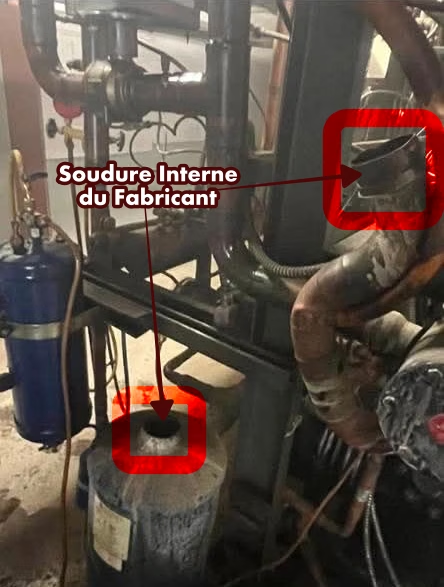
Source: LinkedIn – Adrien Le Norcy
Refrigeration compressor explosion
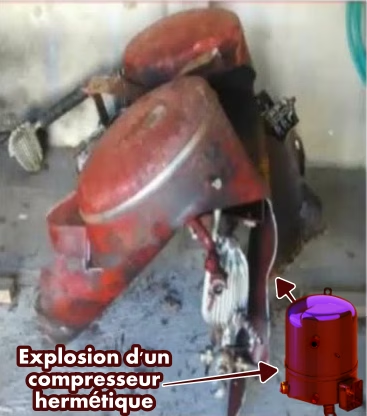
Source: Youtube Video – CEMAFROID
A strong lesson emerges from these incidents
Safety relies not only on equipment quality, but also on the coherence of the system as a whole.
An installation error, improper handling, or lack of monitoring can lead to serious consequences.
Refrigeration facility managers must be trained not only on regulations, but also on:
- Understanding these installations and equipment
- Their operating conditions
- Interactions between components
Statistics on Cold PE (ESPf) accidents
According to ARIA database data:
| Incident type | Percentage |
|---|---|
| Refrigerant leaks | 60 % |
| Explosions or fires | 40 % |
| Cold PE (ESPf) ruptures | 10 % |
| Cold PE (ESPf) explosions | 5 % |
Total number of incidents analyzed: 85
Most affected sectors
- Agri-food industry
- Research centers
- Sports facilities (for example: ice rinks)
- Large and medium-sized supermarkets (GMS)
These figures highlight the importance of rigorous monitoring of refrigeration and air conditioning installations using Cold PE (ESPf).
Prevention of Cold PE (ESPf) accidents
Here are the essential measures to implement to prevent a Cold PE (ESPf) accident:
- Choose resistant materials for installation conditions
- Conduct periodic inspections and requalifications
- Verify maintenance and upkeep of the installation
- Ensure traceability of your installation (DCRR offers cDESP, a digital solution for the in-service monitoring of your cold PE)
Consequences can be severe
Human
- Serious injuries
- Deaths in case of explosion
Economic
- Production stoppage
- Material damage
- Repair costs
Environmental
- Leakage of polluting or toxic fluids
Legal
- Criminal and civil liability of the operator
The role of digitalization in Cold PE (ESPf) safety
Facing these challenges, digitalization of equipment monitoring is a major prevention lever.
Thanks to solutions like DCRR’s cDESP, it becomes possible to:
- Track each operation
- Automatically archive inspection reports
- Receive alerts on deadlines
This type of platform:
- Centralizes documents
- Ensures perfect installation monitoring
- Improves reactivity to anomalies
The platform also allows one-click generation of:
- The PED dossier
- The Art 6-III list
- The biennial REX mandatory for any installation subject to in-service monitoring
This guarantees not only better regulatory compliance, but also traceability accessible at all times, essential in case of inspection or incident/accident.
Digital technology thus transforms regulatory constraint into an opportunity for proactive risk management.
Regulations and obligations
In Europe, PE are subject to:
- Directive 2014/68/EU (PED)
- In France, the decree of November 20, 2017
Each installation must be accompanied by a complete PED dossier specifying:
- Operating conditions
- Temperatures
- Safety devices (Art 6-III List)
The operator is legally responsible for the compliance and traceability of equipment.
Conclusion
Cold PE (ESPf) accidents can have dramatic consequences if not anticipated. Between technical failures and poor installation practices, the risk is real.
By combining:
- Knowledge of past incidents
- Prevention measures
- Regulatory rigor
Companies can effectively control these dangers. For this, surrounding yourself with experts like DCRR is a guarantee of safety and compliance.
Useful resources
Source: The DCRR team